Dr. Joyee Mitra , Scientist-E & Associate Professor, AcSIR 9956713222, joyeemitra.immt@csir.res.in , https://sites.google.com/view/mitragroupcsmcri/home
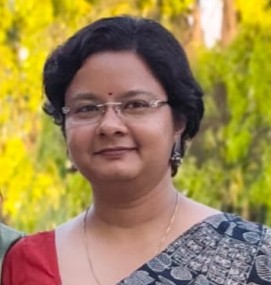 DESCRIPTION :
Dr. Joyee Mitra is presently
employed as a Principal Scientist (Scientist–E) in the Materials Chemistry and
Interfacial Engineering Department at the CSIR–Institute of Minerals and
Materials Technology (CSIR–IMMT), Bhubaneswar. She obtained her B.Sc. and M.Sc.
degrees in Chemistry from Jadavpur University, Kolkata, followed by a Ph.D.
from the Indian Institute of Technology Kanpur (IIT Kanpur). She subsequently
pursued postdoctoral research at the University of Illinois Urbana–Champaign
(USA), where her work focused on biomimetic systems for hydrogen production and
utilization, as well as the catalytic valorization of lignocellulosic biomass
into value-added chemicals and fuel additives. She later joined CSIR–Central
Salt & Marine Chemicals Research Institute (CSIR–CSMCRI), Bhavnagar as a
DST–INSPIRE Faculty.
In 2019, Dr. Mitra joined
CSIR–CSMCRI as a Senior Scientist and established the Metallogels and Inorganic
Materials Group. Her research centers on the design and development of
nanostructured functional inorganic materials, particularly low-molecular-weight
gelator-based supramolecular metallogels and gel-derived systems, as well as
metal-free hydrogen-bonded and covalent materials. These systems are explored
for applications in catalysis, photocatalysis, and electrocatalysis, including
small-molecule activation (CO₂, SO₂, etc.), organic transformations, pollutant
sequestration, and energy conversion/storage technologies such as
electrocatalytic water splitting.
A major component of her research
program focuses on the recovery of lithium and other critical metals from waste
streams, including e-waste, contributing to sustainable “waste-to-wealth”
strategies and circular resource utilization. Her group is also actively
engaged in developing purpose-designed functional materials for healthcare and
biomedical applications.
For further details, please refer
to the group webpage: https://sites.google.com/view/mitragroupcsmcri/home
Google Scholar profile: https://scholar.google.com/citations?user=Gr-NzpwAAAAJ&hl=en
Current Ph.D. students:
- ·
Mr. Hiren Jungi
- ·
Ms. Asma Virani
- ·
Ms. Sumana Podder
- ·
Mr. Harpal Girase
Former Ph.D. students:
- · Dr. Ekata Saha
- Dr. Ashis Chhetri
EXPERIENCE :Principal Scientist & Associate Professor, AcSIR (April
2026-Present), CSIR-IMMT Bhubaneswar, Odisha, India.
Principal Scientist & Associate Professor, AcSIR (Jan
2023-April 2026), CSIR-CSMCRI Bhavnagar, Gujarat, India.
Senior Scientist & Assistant Professor,
AcSIR (Jan 2019-Jan 2023), CSIR-CSMCRI Bhavnagar, Gujarat, India.
AREA OF INTEREST :The Mitra Group focuses on the
design and development of nanostructured functional materials, including
supramolecular metallogels and hydrogen-bonded systems, for applications in
catalysis (photo/electrocatalysis), pollutant sequestration, and energy conversion.
A parallel research thrust of the group involves the sustainable recovery of
lithium and other critical metals from waste streams and electronic waste
through circular “waste-to-wealth” strategies aimed at resource recovery and
reuse.
Our research broadly spans the following themes:
Supramolecular Metallogels and Gel-Derived Materials
We develop supramolecular
metallogels with tunable physicochemical, structural, and electronic
properties, and explore their transformation into functional gel-derived
materials. Our research seeks to understand the fundamental aspects of gel
formation, self-assembly, and structure–property relationships, while
simultaneously advancing their practical applications in catalysis, pollutant
sequestration, sensing, and healthcare-related applications.
Charge-Assisted and Neutral Hydrogen-Bonded Organic
Systems
Hydrogen-bonded organic materials
are an emerging class of crystalline functional systems assembled through
directional hydrogen-bonding interactions between complementary molecular
building blocks. In contrast to coordination-based frameworks, these materials
often exhibit self-healing behavior, recyclability, and solution
processability. Charge-assisted hydrogen-bonded systems offer enhanced
structural stability due to strong electrostatic interactions between their
constituents. Our group is particularly interested in the design of both
neutral and charge-assisted hydrogen-bonded systems, including chiral
materials, for applications in catalysis, selective pollutant capture, and molecular
separation.
Recovery of Critical Metals from E-Waste
A major focus of our research is
the development of ligand systems and sustainable processes for the selective
recovery of critical metals from waste streams, particularly electronic waste.
With increasing demand for metals used in electric vehicles, batteries, and
energy conversion/storage technologies, efficient recycling and reuse have
become strategically important. Our work primarily emphasizes selective
precipitation-based recovery approaches for lithium and other value-added
metals, followed by their reintegration into functional materials and catalytic
systems, thereby contributing to a circular economy framework.
Functional Materials for Photo- and Electrocatalysis
The design of advanced catalytic materials for
photo- and electrocatalysis requires precise control over electronic structure,
surface chemistry, charge transport, and catalytic active sites. Our group
employs a range of strategies including scaffold modification, defect
engineering, heterostructure construction, and coordination environment
modulation, to enhance catalytic efficiency, selectivity, and stability. We are
particularly interested in developing functional materials for water splitting
and small-molecule activation reactions such as CO2 and N2
conversion, with the broader goal of advancing sustainable energy and chemical
transformations.
RECENT PUBLICATIONS :1. H. Jungi, A. Chhetri, D. Kumar, S. Podder,
R. S. Malavika, R. Kuniyil, J Mitra. Bifunctional picolinate ionic
liquids as metal-/halide-free sustainable catalysts for CO2
cycloaddition to epoxides. Catal. Sci. Technol., 2026, 16, 458-468. DOI:
10.1039/D5CY01068C
2. A. Chhetri, S. Ahmad, S. Podder, S. Tothadi,
S. Maniam, C. M. Reddy, J. Mitra. Correlating Nanomechanical Behavior
and Adsorption Performance in a Serendipitously Assembled Two-Dimensional
Hydrogen-Bonded Organic System. Langmuir, 2026, 42, 609-618. DOI:
10.1021/acs.langmuir.5c04711
3. S. Podder, H. Jungi, J. Mitra. In
Pursuit of Carbon Neutrality: Progresses and Innovations in Sorbents for Direct
Air Capture of CO2. Chem Eur. J., 2025, 31, e202500865. DOI:
10.1002/chem.202500865
4. N. Choudhary, H. Jungi, M. V. Gauswami, A.
Kumari, A. B. Boricha, J. R. Chunawala, J. Mitra, A. R. Paital. A
closed-loop zero-liquid-discharge process for the precipitative separation of
all valuable metals from waste lithium-ion batteries of mixed chemistries at
room-temperature. Green Chem. 2025, 27, 4267-4279. DOI: 10.1039/D5GC00054H
5. S. Podder, R. Madhu, S. Kundu, J. Mitra.
Probing Under-Utilized Melem as Host Scaffold with Strategic Modulation of
Cobalt Oxidation State to Accelerate Alkaline Water Splitting. Small, 2025, 21,
2501949. DOI: 10.1002/smll.202501949
6. H. Jungi, A. A. Virani, S. Podder, H.
Girase, J. Mitra. Sustainable Combination of Waste with Waste:
Utilization of Biomass to Recover Critical Metals from Spent Lithium-ion
Batteries (Hot Topic: Biomass Upgrading). Batter. Supercaps 2024, e202400518.
DOI: 10.1002/batt.202400518
7. E. Saha, A. Khan, A. I. Mallick, J. Mitra.
Purpose-built multicomponent supramolecular silver(I)-hydrogels as
membrane-targeting broad-spectrum antibacterial agents against
multidrug-resistant pathogens (Themed Collection: Bioinspired Functional
Supramolecular Systems). J. Mater. Chem. B, 2024, 12, 8767-8777. DOI:
10.1039/d4tb01355g
8. A. Chhetri, A. Maibam, S. Maniam, R.
Babarao, K. Wilson, A. F. Lee, J. Mitra. A Heterogeneous Acid-Base
Organocatalyst For Cascade Deacetalisation-Knoevenagel Condensations. ChemSusChem
2024, 17, e202400866. DOI: 10.1002/cssc.202400866
9. A. Chhetri, A. Biswas, S. Podder, R. S. Dey,
J. Mitra. Strategic design of VO2 encased in N-doped carbon
as an efficient electrocatalyst for the nitrogen reduction reaction in neutral
and acidic media. Nanoscale. 2024, 16, 9426-9435. DOI: 10.1039/D4NR00640B
10. E. Saha, H. Jungi, S. Dabas, A. Mathew, R.
Kuniyil, S. Subramanian, J. Mitra. Amine-rich Nickel(II)-Xerogel as a
Highly Active Bifunctional Metallo-organo Catalyst for Aqueous Knoevenagel
Condensation and Solvent-free CO2 Cycloaddition. Inorg. Chem. 2023, 62,
14959-14970. DOI: 10.1021/acs.inorgchem.3c01669
11. E. Saha, A. Rahaman, S. Bhadra, J. Mitra.
Exploring Amine-rich Supramolecular Silver(I)-Metallogels for Autonomous
Self-healing and as Catalysts for Three Component Coupling Reaction. Dalton
Trans., 2023, 52, 15530-15538. DOI: 10.1039/D3DT01654D (Themed collection:
New Talent: Asia Pacific)
12. H. Jungi, A. Karmakar, S. Kundu, J.
Mitra. Waste is the Best: End-of-Life Lithium Ion Battery-derived
Ultra-active Ni3+-Enriched β-Ni(OH)2 for Electrocatalytic
Oxygen Evolution Reaction. J. Mater. Chem. A, 2023, 11, 13687-13696 DOI:
10.1039/D3TA01989F
13. A.
Chhetri, K. Karthick, A. Karmakar, S. Kundu, J. Mitra. Melamine-based
Hydrogen-bonded Systems as Organoelectrocatalysts for Water Oxidation Reaction. ChemSusChem, 2023, 16, e202300220. DOI:
10.1002/cssc.202300220
14. E.
Saha, A. Chhetri, P. P. Venugopal, D. Chakraborty, J. Mitra. A
chemically robust amine-grafted Zn(II)-based smart supramolecular gel as a
regenerative platform for trace discrimination of nitro-antibiotics and
assorted environmental toxins. J. Mater. Chem. C, 2023, 11, 3252-3261. DOI:
10.1039/D2TC04700D
15. E.
Saha, G. R. Bhadu, J. Mitra. Ni(II) supramolecular gel-derived Ni(0)
nanoclusters decorated with optimal N, O-doped graphitized carbon as
bifunctional electrocatalysts for oxygen and hydrogen evolution reactions. Int.
J. Hyd. Energy, 2023, 48, 8115-8126. DOI: 10.1016/j.ijhydene.2022.11.256
PATENTS :1. A. R. Paital, A. B. Boricha, J. Mitra,
J. R. Chunawala, M. V. Gauswami, A. Kumari, H. Jungi, N. Choudhary. A
zero-discharge hydrometallurgy-based process for the recovery of valuable
metals from spent lithium ion batteries.
INDIA No.
202111052187 Filed on 12 Nov 2021. Publication
date 12-05-2023

